I've written before about a Mexico City hotel lobby that used zero direct downlights and taught me to think differently about ambient light. That lesson stuck with me. So when a lighting rep in Austin told me about a new restaurant where "you can't see where the light comes from," I booked a table for that same week.
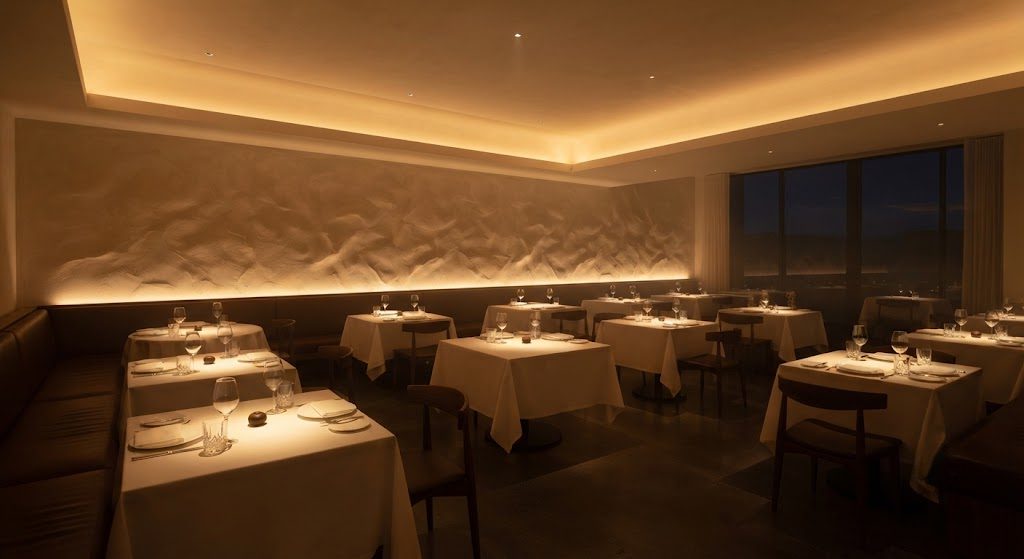
She was right. I sat at the bar for an hour after my meal, nursing a coffee and cataloging every technique I could identify. The ceiling was blank — no recessed trims, no pendants, no track heads. The walls had no sconces. The tables had no lamps. Yet the room glowed warmly, each table was perfectly lit, and a textured plaster wall at the back of the dining room looked three-dimensional in a way I'd only seen in galleries. Here's what was actually happening, and what you can take from it.
The Ceiling That Lit the Tables
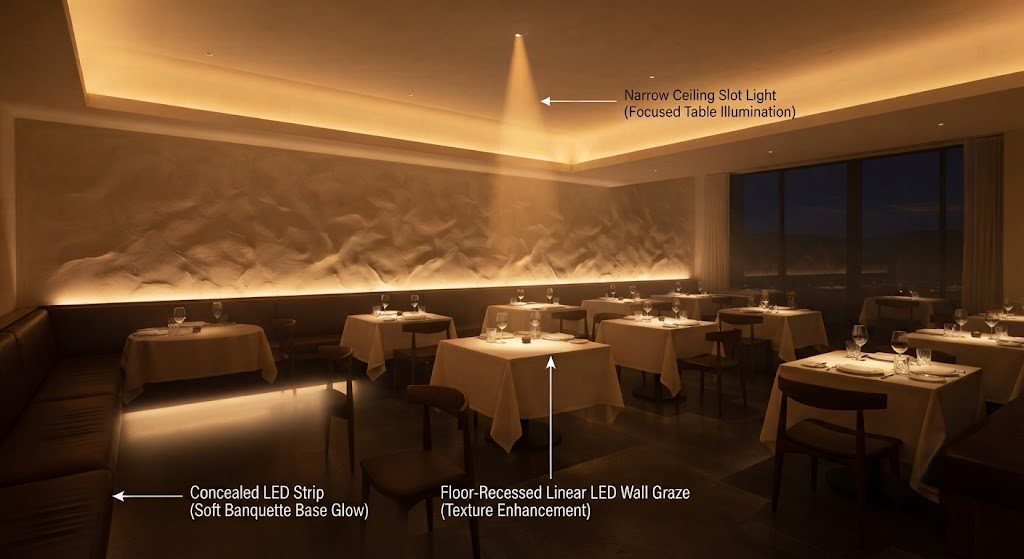
The first technique revealed itself when I looked up from my table. A narrow slot — maybe 4 inches wide — ran in a linear pattern across the ceiling, directly above the line of tables below. Inside that slot, hidden from every sightline, a strip of warm LED tape with a focused lens pushed a narrow beam of light straight down onto each tabletop.
The Slot-Downlight Principle
This is not a recessed can. It's a continuous slot — a drywall detail with an LED extrusion inside, aimed straight down through a narrow opening. The ceiling slot acts as a built-in baffle, blocking any view of the light source from across the room. You only see the effect: a defined pool of light on the tablecloth, bright enough to read a menu, contained enough to feel intimate.
In a home, this translates to a linear slot over a dining table or kitchen island — the same pendant replacement I discussed in the pendant height guide, but taken further. Instead of hanging fixtures, the light comes from a drywall reveal in the ceiling, built during rough-in. The construction isn't complicated: two parallel pieces of drywall spaced 3 to 4 inches apart, with an LED extrusion mounted inside and a focused lens to control the beam. Your drywall contractor can build it. Your electrician can wire it. The cost is a few hundred dollars in materials and labor — less than many designer pendants — and the result is a dining table that glows from above with no hardware in sight.
The Back Wall That Ate Light
The dining room's feature wall was dark plaster with a pronounced hand-troweled texture. No picture lights. No spots. Yet it glowed — a soft, even radiance that seemed to come from within the wall itself. I walked closer and found the source: a continuous linear LED strip recessed into the floor, set about 2 inches from the wall surface, washing upward.
The Concealed Grazer
This is grazing light taken to its logical extreme. I covered the basic grazing technique in the Mexico City hotel post, but this restaurant went further. The floor channel was invisible unless you stood directly over it. The LED strip inside was set deep enough that no diode was visible from any standing angle. The light skimmed up the textured plaster surface at a nearly parallel angle, and every ridge and depression cast a micro-shadow that made the wall feel physically deep.
In a residential setting, you can replicate this on a textured fireplace surround, a stone accent wall, or a plaster feature in an entryway. An aluminum extrusion with a frosted lens, recessed into the floor or the base of the wall, wired to a low-voltage LED strip. The key is the setback from the wall — 2 inches is the sweet spot for creating visible texture shadow without washing out the surface. Any closer and the wall goes flat. Any farther and you lose the grazing angle entirely.
The Banquette That Floated
The third technique was the simplest and most easily stolen for a home. The restaurant's upholstered banquette seating appeared to float above the floor because a continuous LED strip was mounted underneath the bench, concealed by a recessed toe kick detail. The warm light spilled onto the floor in a soft pool that defined the edge of the seating without calling attention to itself.
This is toe-kick lighting — the same approach I recommend for kitchen islands and bathroom vanities, but applied to seating. It creates a sense of lightness, defines the perimeter of furniture, and provides just enough ambient fill at floor level to keep the room from feeling bottom-heavy. A plug-in LED strip with an adhesive backing, mounted under a sofa or a built-in bench and connected to a smart plug, costs under forty dollars and installs in ten minutes. No electrician required.
The Philosophy Worth Borrowing
That restaurant taught me something beyond specific techniques. The designers made one rule and stuck to it: no light source within the diner's field of view. Every fixture was hidden behind, inside, or under something. The light reached your eye only after bouncing off a surface — a table, a wall, a floor — which meant it always arrived softened and colored by the material it touched. That's why the room felt so calm. There was nothing to squint at.
You don't need to eliminate every visible fixture in your home. But you can steal the principle. For every room, ask: is there one surface I can light indirectly? One ceiling slot, one floor grazer, one hidden strip that makes the room glow without announcing how? The restaurant where you can't see a single fixture isn't showing off. It's showing what light can do when it's allowed to be the experience, not the object.