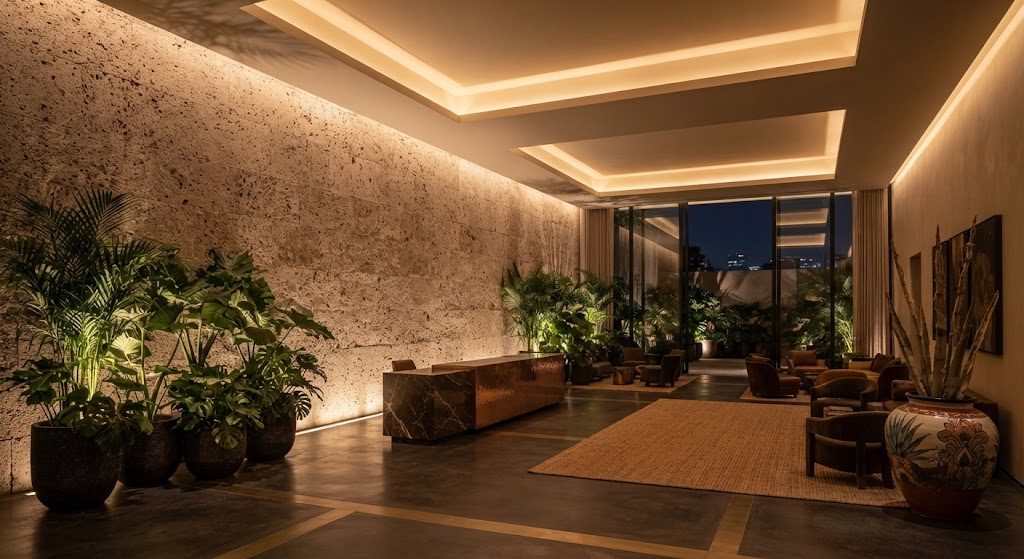
I plan my travel around buildings the way some people plan theirs around restaurants. A few years ago, that habit took me to Mexico City, where a colleague told me I needed to see the lobby of a hotel that had been redesigned by a firm known for their lighting work. I walked in at dusk, looked up to find the fixtures, and realized there was nothing to look at. Every light source was hidden.
The effect was immediate and physical. The room felt calm in a way that's hard to describe — like the visual equivalent of ambient music. No glare. No hot spots on the floor. No obvious source saying "here is where the light comes from." Just a room that seemed to glow from within.
I spent two hours in that lobby with my camera and a notepad. Here's what I learned, and how it applies to your living room.
The Ceiling That Wasn't There
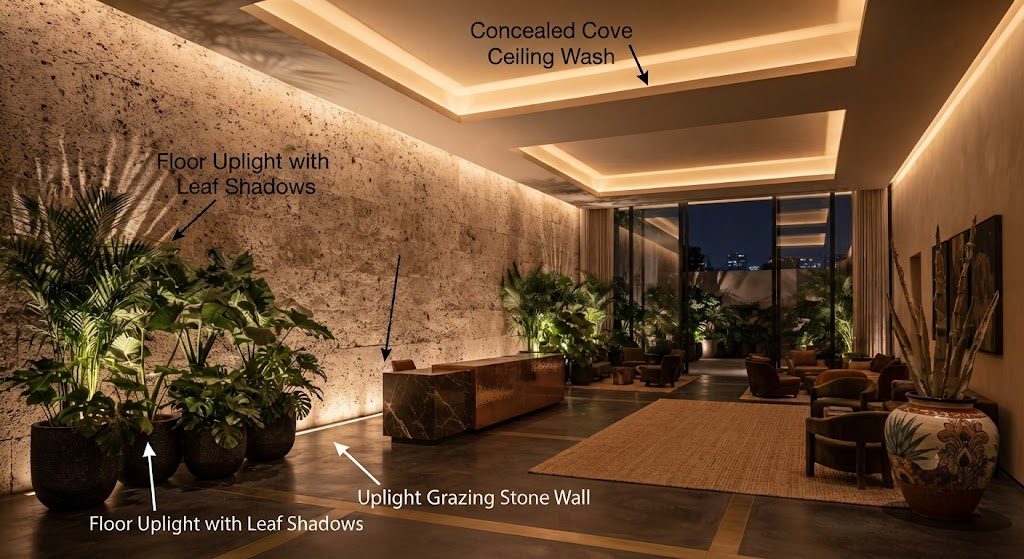
The first thing I noticed was the ceiling. It wasn't lit — it was luminous. A continuous cove ran around the perimeter where the walls met the ceiling, and inside that cove, a strip of warm LED tape threw light upward across the ceiling plane. The ceiling itself became the light source, bouncing soft illumination down into the room.
Why This Works
Direct downlights — the recessed cans I see in nearly every American home — put bright circles on the floor and leave the ceiling in shadow. Your eye reads the dark ceiling as lower than it actually is, which compresses the room visually. Indirect cove light does the opposite. A bright ceiling reads as open sky, making the room feel taller and more expansive. The physics is simple: light surfaces your eye can see, not surfaces your eye ignores.
This technique translates directly to residential spaces. You don't need a hotel-sized ceiling cove. A single run of LED tape concealed behind a crown molding or a simple drywall ledge along one wall can wash enough light across your ceiling to change how the whole living room feels. The critical detail: keep the LED strip far enough back from the edge that you can't see the individual diodes — typically a 2-inch setback minimum. If you can see the dots, you've built a disco, not a cove.
The Walls That Glowed
The second thing I studied was a long wall of textured stone that served as the lobby's visual anchor. No picture lights. No track heads. Instead, a narrow linear fixture recessed into the floor cast a grazing wash up the entire surface.
Grazing Light and What It Does to Texture
Grazing is what happens when you place a light source very close to a textured surface, aimed almost parallel to it. Every bump, ridge, and groove casts a tiny shadow, and the texture leaps forward visually. The stone wall in that lobby felt ancient and substantial because the light revealed its surface, not just its color. From 30 feet away, you didn't just see a wall — you felt it.
You can borrow this at home with a textured wall, a brick fireplace, or a stone backsplash. A linear LED strip mounted in a floor channel or a low-profile uplight tucked tight against the base of the surface creates the same effect. The grazing light I discussed in the recessed lighting guide applies here: beam angle matters, and a wide flood will wash out the texture while a tighter beam at close range will amplify it.
The Plants as Sculpture
The third technique was the simplest: uplights hidden behind planters. Large tropical plants sat in concrete troughs, and a small in-grade uplight at the base of each one threw a canopy of leaf shadows onto the wall behind them. The plants became sculptures. The shadows became art. The light source was invisible.
How to Think Like That Designer
The designer of that lobby made one decision that rippled through everything else: no light hits the floor directly. Every source was aimed at a surface — ceiling, wall, plant — and the room's illumination came entirely from reflected light. Reflected light is always softer and more flattering than direct light because the surface diffuses it before it reaches your eye.
In your home, this doesn't mean eliminating recessed lights. It means asking whether your ambient layer could come from indirect sources instead of another grid of downlights. A cove detail in the living room. A floor grazer on a stone fireplace. An uplight behind a tall houseplant. These are not expensive installations. They're placement decisions that cost the same as a recessed light but deliver an entirely different quality of light.
The Mexico City lobby didn't look designed. It looked inevitable — like the light belonged to the space rather than being imposed on it. That's the goal worth chasing.