
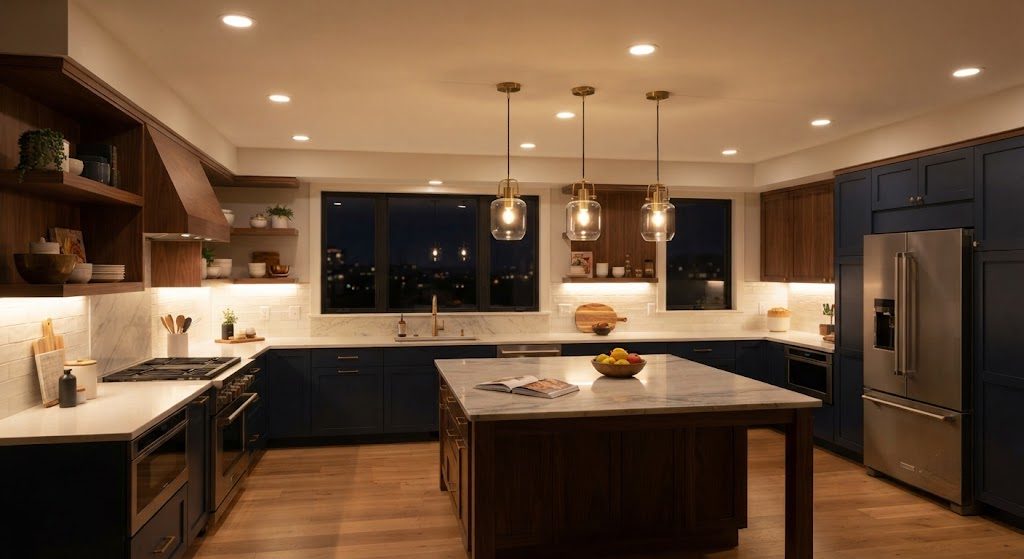
The kitchen is the room where bad lighting has consequences. You're handling sharp knives, reading recipes, and transferring hot pans between surfaces. If you can't see clearly, you're not just annoyed — you're compromising safety. Yet most kitchens I walk into have a single ceiling fixture in the center and maybe a pendant over the island if someone thought ahead. Everything else happens in shadow.
A kitchen needs three distinct zones of task light, a proper ambient base, and a touch of accent to feel complete. Let's build it layer by layer.
Task Light: The Three Zones That Matter
Task light puts focused illumination exactly where your hands do work. In a kitchen, that means three surfaces need dedicated light — not light that happens to spill over from somewhere else.
Zone 1: Perimeter Countertops
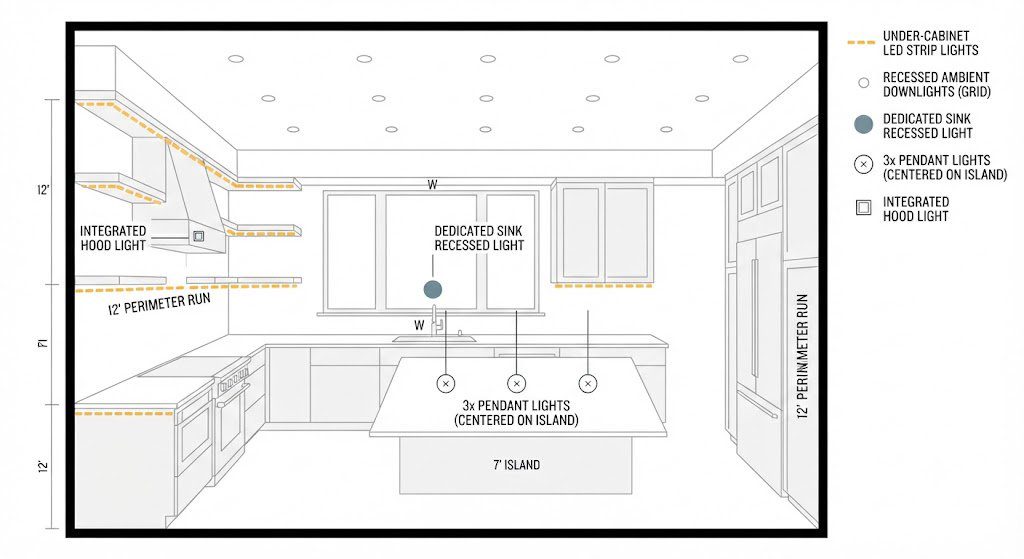
Every countertop where you prep, chop, or plate needs shadow-free task light. The most effective way to deliver this is with under-cabinet LED strips. Position them at the front edge of the upper cabinets, not the back. Mounting them at the front pushes light across the entire counter depth and eliminates the shadow your body casts when you lean over the surface. Hardwire them during rough-in if your walls are open; plug-in strips work for retrofits but leave visible cords.
For color temperature, stick to 3000K. It renders food colors accurately and keeps your whites looking clean without feeling like an operating room. A topic I covered in detail in the color temperature guide — 2700K makes fresh vegetables look dull, and 4000K belongs in a commercial kitchen, not your home.
Zone 2: The Island or Peninsula
If you have an island, it's doing double duty as prep surface and gathering spot. Pendants are the standard solution, but placement and height make or break the result. Space pendants evenly across the island length, roughly 24 to 30 inches apart center-to-center. The bottom of the pendant should sit 30 to 36 inches above the counter surface — and no, the 30-to-36-inch rule doesn't automatically work for tall ceilings. If your ceiling is 10 feet or higher, you may need to hang slightly lower to keep the light where it belongs instead of losing it to the volume above.
Choose pendants with downward-directed light and a shade that shields the bulb from direct sightlines. You want to see the light on the counter, not the glare of the bulb from across the room.
Zone 3: The Sink
The sink is often forgotten because it sits under a window. That window provides beautiful daylight, but at 8 PM in December, it's a black rectangle. A recessed light or a small pendant directly over the sink — on its own switch — means you're not washing dishes in your own shadow.
Ambient Light: The Ceiling Grid
Task light handles the counters, but the floor, the ceiling, and the walkways still need base illumination. A grid of recessed lights across the kitchen ceiling fills this role. Space them evenly, aim for wide-flood trims with at least a 40-degree beam angle, and keep them on a separate dimmer from the task circuits. When you're entertaining and the cooking is done, drop the task lights and keep the ambient at a warm glow.
Accent Layer: The Cabinets and Toe Kicks
Kitchen accent light is optional but transformative. LED tape inside glass-front upper cabinets turns dishware into a display. Toe-kick lighting under the base cabinets creates a floating effect that makes the whole kitchen feel lighter and more custom. Both are low-cost additions during rough-in that deliver an outsized visual return.
One Room, Three Circuits
Wire the task, ambient, and accent layers on separate switches — or, better yet, separate dimmers. A kitchen with everything on one switch is either all-on or all-off. A kitchen with three circuits can be bright for meal prep, soft for morning coffee, and atmospheric for evening entertaining. This is the difference between a room that works and a room that works for you.