
How to Choose the Right Flush Mount Ceiling Light for Every Room
If you are fixing a dark hallway or a bedroom with an 8-foot ceiling, start here. A flush mount ceiling light sits tight against the ceiling and spreads even light across the whole room, unlike a pendant that leaves dark corners. This guide covers where these fixtures work best, what to look for, and how to avoid the common mistakes I see in residential projects.
What Makes a Flush Mount Ceiling Light Different
The name says it all. A flush mount ceiling light mounts directly to the ceiling, with no visible stem or hanging chain. That makes it the best choice for rooms with 8-foot ceilings, basement ceilings, and hallways where a pendant would block a doorway or create a head-bump risk. The shade is usually a dome, drum, or stacked design, and the light source points downward or sideways through diffusing glass or acrylic. Because the fixture sits close to the ceiling plane, it produces broad ambient light rather than a focused pool.
One rule I repeat on every project: match the fixture to the ceiling height, not the room size. A semi-flush with an eight-inch drop can make a doorway clearance dangerous. A true flush mount stays close to the ceiling and solves that problem.
Why Your Hallway Needs a Flush Mount Ceiling Light
Hallways are the most neglected rooms in American homes, and they are also where a flush mount ceiling light earns its keep. A narrow corridor with one recessed can at the end creates a tunnel effect. Swap it for a flush mount in the center of the ceiling, and you get uniform light along the whole walkway.
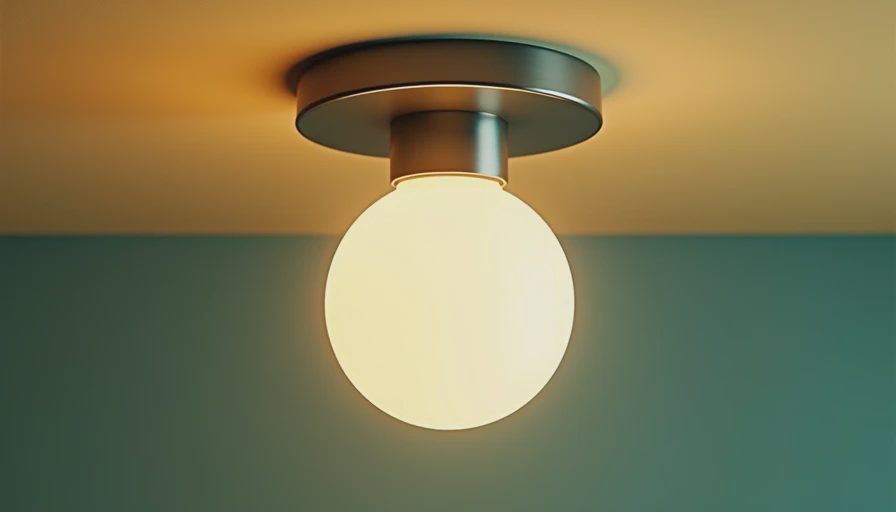
Doorways and picture frames no longer disappear into shadow. For a 10-foot hallway, a single 12-inch flush mount with a frosted diffuser is usually enough. For longer runs, put one every 8 to 10 feet. Don't let the builder-grade fixture from the 1990s stay up there; a new one changes how the entire house feels when you walk in.
The Layer of Light You Are Missing: Ambient
Most lighting plans fail because they have only one layer. Recessed cans on a dimmer might handle a kitchen, but in a bedroom they create a flat, washed-out look. A flush mount fixture gives you the ambient layer: soft, even base light that fills the whole room. From there, add task lights for reading and accent lights for artwork or plants. Put the flush mount on a dimmer so it can drop to 20 percent at night, then bring up a floor lamp next to the sofa. Choose a color temperature around 2700K or 3000K, and look for a CRI of 90 or higher. Warm light works best in living rooms and bedrooms; cooler white is for laundry rooms and garages.
If you are replacing a single overhead socket in a bedroom, steer clear of glaring 5000K bulbs that make a cozy space feel like a waiting room. Pair the flush mount with a bedside lamp on a separate switch. Dim the ceiling and use the lamp in the evening; the room will feel intentional and comfortable.
Shopping for a Flush Mount Ceiling Light: What to Look For
When you buy a flush mount fixture, ask four questions. First, what is the diameter? A common rule of thumb is to add the room's length and width in feet, then use that sum as the diameter in inches. A 12 by 12 room points to a 24-inch fixture, while a 4 by 8 hallway wants something closer to 12 inches. Second, does it take a standard bulb or is the LED integrated? A medium-base socket lets you swap in a dimmable LED later.

Third, what is the mounting system? Look for a metal canopy with slotted screw holes and a sturdy bracket. Cheap plastic canopies crack during installation and sag over time. Fourth, what finish works? Brushed nickel and satin brass are popular, but matte black and white are safe choices if you are not sure.
There is no reason to spend a fortune. Solid mid-range brands include Kichler, Hinkley, and Hunter, with prices from about $80 to $250 for most flush mounts. Big-box lines from Progress or Hampton Bay are fine for a rental, but expect thinner metal and fewer dimming options. If you want a color-tunable chip, plan to go closer to the $300 mark.
Real Room: A Builder-Grade Entryway Fix
Last fall I worked with a family in a 2004 tract home in Cypress, Texas. Their entryway had a tiny 8-inch boob light with a yellowed glass bowl and a pull chain. The ceiling was only 8 feet, so a pendant was out of the question. We swapped it for a 14-inch LED flush mount with a frosted drum and a 3000K color temperature. The project took about 20 minutes and cost $140 for the fixture.
The result was dramatic. The frosted drum eliminated glare, and the warmer color made the white trim look clean instead of gray. The same fixture works in bedrooms, closets, and landings, which is why I often spec one model throughout a house for visual consistency.
The Bottom Line
If you need even, reliable light in a room with a low ceiling, a flush mount ceiling light is one of the most practical upgrades you can make. It solves the tunnel effect in hallways, replaces the dreary boob light, and gives the room a solid ambient base. Start with one hallway or entryway, pick a dimmer and a warm color temperature, and see how much better the space feels. Once you feel the difference, you will understand why lighting design is about placing the right type of light in the right spot.