
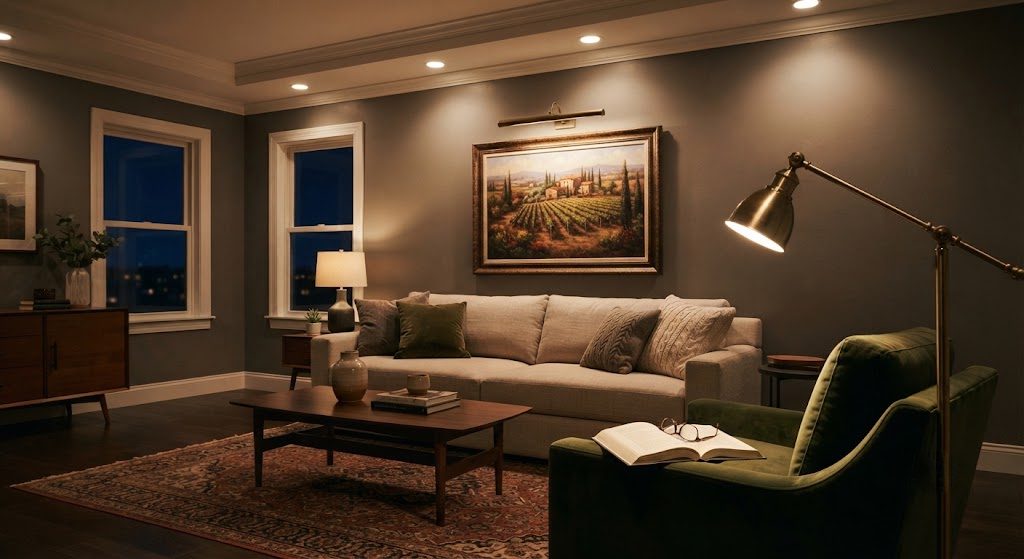
If you read the manifesto that kicked off this site, you know the thesis: most rooms feel dead after dark because they're lit by a single overhead fixture and crossed fingers. The fix isn't a prettier fixture. It's a framework. And that framework is built on three layers of light — ambient, task, and accent.
I didn't invent this. It's how every architectural lighting designer approaches a space, from hotel lobbies to high-end residences. But it's rarely explained in terms that matter when you're standing in your own half-renovated living room, trying to figure out where the wires should go.
Let's fix that.
What Are the Three Layers?
Think of lighting a room the way you'd build a wardrobe. You start with the basics that cover everything, add the pieces that do specific jobs, and finish with accessories that give it personality. Light works the same way.
Layer 1: Ambient Light — The Foundation
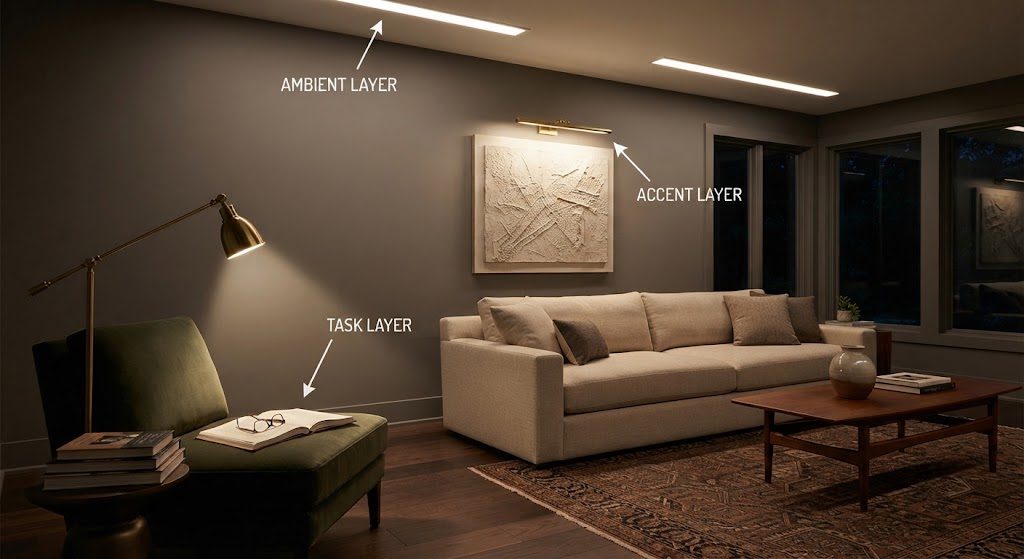
Ambient light is the base layer. Its job is to fill the entire room with soft, even illumination — no harsh shadows, no dark corners. In most homes, this layer is either missing or doing double-duty as the only light source, which is why rooms feel simultaneously blasted and gloomy.
Good ambient light usually comes from indirect sources: recessed downlights aimed at walls (not straight down), cove lighting that bounces off the ceiling, or a large pendant with a diffuser that throws light sideways. The goal is to make the room feel larger and welcoming — like daylight, just dimmer and warmer.
Layer 2: Task Light — The Workhorse
Task light is the focused beam that makes functional spaces functional. It's the light over your kitchen island that illuminates a cutting board, the reading lamp beside your favorite chair, the vanity sconces that let you shave or apply makeup without shadows carving lines into your face.
A good rule of thumb: if an activity requires your hands and eyes to work together, it needs dedicated task light. Position it to come from the side or slightly in front of you — never from behind your head, where it casts your own shadow onto the work surface.
Layer 3: Accent Light — The Sculptor
If ambient light fills the room and task light makes it useful, accent light makes it memorable. This layer highlights the things you want people to notice: art, architectural details, textured walls, a bookshelf that deserves more than darkness.
Accent fixtures are directional — picture lights, adjustable recessed spots, small uplights tucked behind a plant. They typically need to be about three times brighter than the ambient light on the surface they're highlighting to create visible contrast. That ratio is what gives a room a sense of depth and intention.
Why the Order Matters
You design lighting from the ground up — ambient first, then task, then accent. This isn't arbitrary. If you start by picking a dramatic pendant or a row of recessed spots without establishing the base layer, you'll end up with bright islands of light floating in darkness. Lay the foundation first, then add the specific beams, then sculpt the details.
The order also affects your electrician's rough-in. Ambient circuits get placed to cover the whole room. Task circuits land exactly where counters, desks, and vanities will be. Accent circuits are the final pass — and the easiest to adjust if you've already got good ambient and task coverage.
Making Them Work Together
Here's the single most important wiring decision you'll make: put each layer on its own dimmer switch.
When ambient, task, and accent share a circuit, you get one flavor of light — on or off. When they're separated, you can dial the room's mood. Evening entertaining? Bring the accent lights up and drop the ambient to a warm glow. Cleaning up after dinner? Crank the task lights and leave the rest off. A room with three independent dimmers feels like three different rooms depending on the time of night and what you're doing in it.
This is the framework that runs through every post on The Fixture Guide. In the next article, we'll apply it to a real living room that currently feels dead after sunset — and I'll show you exactly what to add, where to place it, and what a difference three layers make.