
Your living room probably has nice furniture, a rug you spent too much on, and wall art someone helped you hang. During the day, it looks great. Sunlight pours through the windows, everything feels open, and you feel good about the space.
Then the sun goes down.
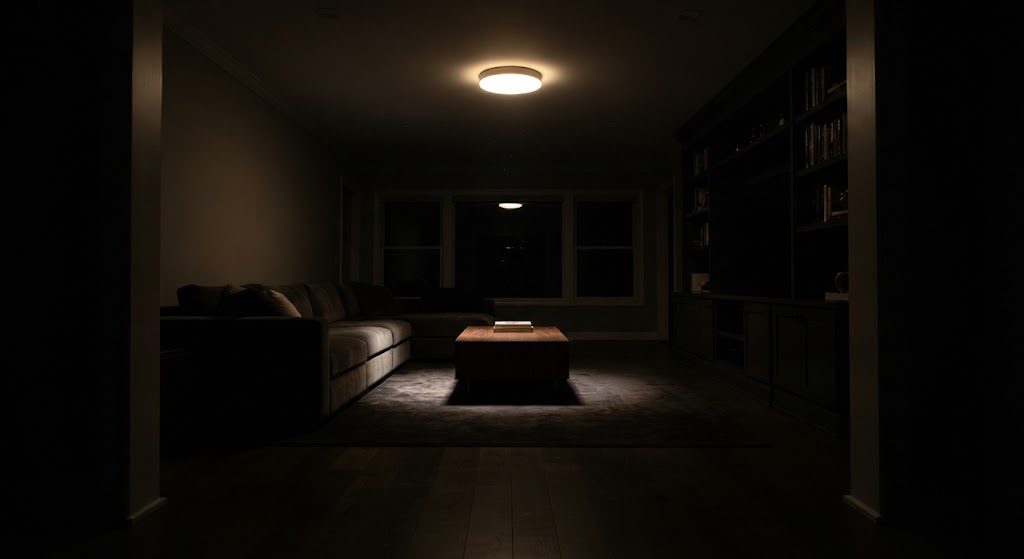
You flip the switch, the single ceiling fixture comes on, and suddenly the room feels completely different — smaller, harsher, less inviting. The couch looks lumpy. The corners disappear. That art you love? Invisible in shadow. You blame the paint color or the furniture arrangement, but the real culprit is sitting on your ceiling.
I see this in roughly 80 percent of the homes I walk into. Let's walk through exactly what's happening, and then I'll show you the fix.
The Anatomy of a Dead Living Room
Imagine a typical 16-by-20-foot living room with 9-foot ceilings. One flush-mount or semi-flush fixture in the center of the ceiling, probably with two or three bare bulbs shining straight down. That's the only light source in the entire room. Here's what that single fixture actually does to the space after dark.
The Ceiling Disappears
Light shoots straight down from the fixture, hits the floor and furniture, and stops. Very little light bounces upward or sideways. The result: a bright pool in the center of the room and a ceiling that looks dark and low. Visually, the ceiling appears to drop about a foot, making the whole room feel compressed.
The Corners Go Dark
A single overhead fixture creates a sharp falloff — the drop in brightness as you move away from the center. By the time you reach the room's corners, light levels are down to 10 or 20 percent of what's in the middle. Your eye perceives darkness at the edges, which makes the room feel much smaller than it actually is. Psychologically, people gravitate toward the bright center and the perimeter seating becomes unused dead space.
Everything Looks Flat
Light from a single direction eliminates texture and depth. Your textured throw pillows look smooth. The books on your shelves cast harsh, unflattering shadows. Faces look tired because overhead light creates deep shadows in eye sockets and under the chin. This is the same reason bathrooms with a single ceiling fixture make you look ten years older — and your living room is doing it to everyone who sits in it.
What Three Layers Actually Do
Now let's take that same living room and rebuild the lighting with the framework I introduced in the last post — ambient, task, and accent on separate dimmers.
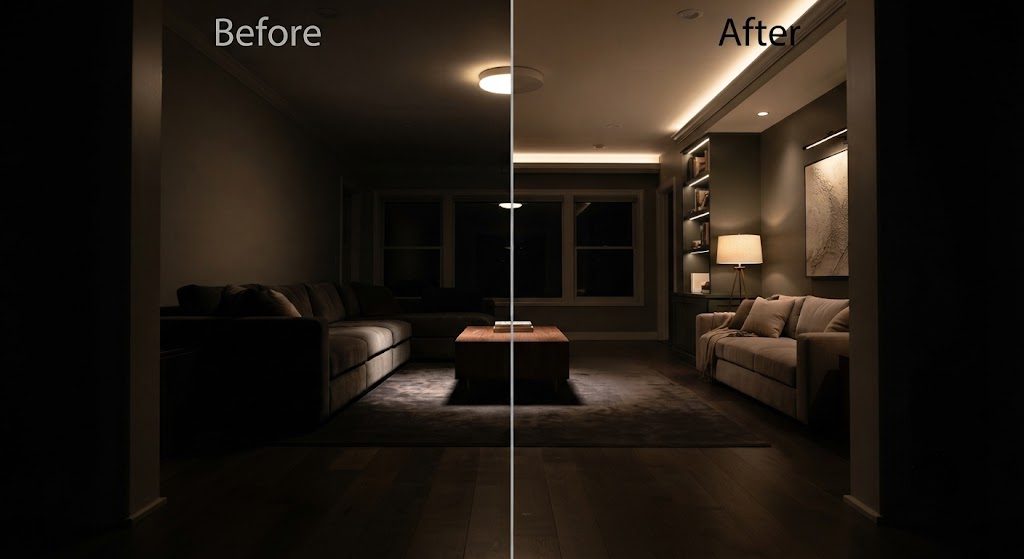
Ambient layer: Instead of one center fixture blasting straight down, we install four recessed lights around the perimeter aimed at the walls. The light bounces off the wall surfaces and fills the room evenly. The ceiling suddenly feels taller, the corners are visible, and the whole room opens up. This alone transforms the space.
Task layer: We add a floor lamp next to the reading chair and a table lamp on the console behind the sofa. Now there are pools of focused light exactly where people sit, read, and have conversations. Faces look better because the light comes from the side instead of straight down.
Accent layer: A small picture light over the art above the sofa and an adjustable recessed spot washing the bookshelf. These create visual hierarchy — your eye goes to the highlighted elements, and the room feels composed rather than assembled.
The three layers on separate dimmers mean you can tune the room for movie night, a dinner party, or quiet reading. That's not a decorating upgrade. It's a different room.