When a replacement light bulb refuses to screw into a fixture, the problem is often the socket rather than the bulb itself. Understanding candelabra base vs standard base helps you choose the correct lamp before you open the package. The difference is simple: one has a smaller screw base, while the other is the familiar medium-size base used in many household lamps and fixtures. That small measurement affects fit, appearance, wattage options, and the kind of fixture you can use.
What the two bulb bases mean
A candelabra base is commonly designated E12. The E refers to Edison screw threads, and the 12 refers to the approximate diameter of the base in millimeters. It is narrow and delicate-looking, which is why manufacturers often use it in chandeliers, decorative sconces, ceiling fans, and ornamental lamps. An E12 bulb might have a flame-tip, torpedo, globe, or small candle-shaped envelope.
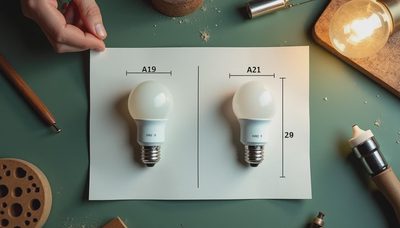
A standard base is usually called a medium base or E26 base in the United States. The E26 designation means the screw base is approximately 26 millimeters across. This is the everyday socket found in many table lamps, floor lamps, recessed housings, pendants, and outdoor fixtures. A19 household bulb, for example, almost always uses an E26 base, although the A19 label describes the bulb shape rather than the socket.
So, in practical terms, candelabra base vs standard base is a comparison between a narrow E12 connection and a wider E26 connection. They are not interchangeable. An E12 bulb will not safely fit an E26 socket, and an E26 bulb will not fit an E12 socket without a properly rated adapter or a replacement socket.
How to identify the socket in your fixture
Start with the fixture turned off and cool. If the old bulb is available, read the printing near its base or on the carton. Look for E12 or E26. When there is no label, compare the socket with a known bulb. An E12 socket is visibly slimmer, closer to the diameter of a small marker. An E26 socket is wider, roughly the size of the base on a typical household bulb.
Do not judge by the glass shape. A decorative candle bulb can use an E12 base, but a similar-looking flame-tip bulb can also be made with an E26 base. The shape tells you how the lamp looks; the threaded metal base tells you whether it fits. This distinction is especially important with chandeliers, where the fixture may look designed for a particular bulb style but still require careful confirmation.
If the fixture has multiple sockets, inspect every socket for damage, looseness, or discoloration before installing new lamps. A cracked socket or browned terminal can indicate heat or wiring trouble. In that situation, changing bulb styles will not solve the underlying problem.

Why the base changes the design of a room
The choice affects more than installation. Candelabra bulbs tend to support a refined, decorative appearance. In a dining room chandelier, six E12 flame-tip bulbs can echo the silhouette of candle flames and keep the fixture visually light. Their smaller envelopes also work well when several lamps are grouped close together.
E26 bulbs offer a broader range of practical light sources. You can find standard-base LED bulbs in many brightness levels, color temperatures, beam shapes, and color-rendering options. For a reading lamp, an E26 LED producing around 800 lumens can provide useful task light without requiring a large fixture. For a decorative pendant, a lower-output filament-style LED may create a warmer, softer glow.
This is where candelabra base vs standard base becomes a design decision rather than a hardware detail. A narrow E12 lamp can preserve the proportions of a small sconce, while an oversized E26 bulb may make the same fixture look crowded. Conversely, putting a tiny E12 lamp into an adapter inside a large shade can leave the shade dim and visually unbalanced.
Brightness, heat, and LED choices
Base size does not determine brightness by itself. An E12 LED can produce substantial light, and an E26 incandescent bulb can be relatively dim. Check lumens for brightness, watts for energy use and fixture limits, and Kelvin rating for color appearance. Around 2700K usually feels warm and residential; 3000K appears cleaner while remaining comfortable in many kitchens and bathrooms.
LED technology has made the old assumption that small-base bulbs are weak less reliable. A quality E12 LED may provide enough light for a hallway, powder room, or chandelier, while an E26 LED is often easier to find in high-output formats for kitchens and work areas. Look for a color rendering index, or CRI, of 90 or higher where you want materials, food, artwork, or skin tones to appear natural.
Also check whether the fixture is rated for enclosed use, damp locations, or dimming. A bulb can have the correct thread and still be the wrong choice for a sealed globe or covered outdoor fixture. The base answers the fit question; the rest of the label answers the performance and safety questions.

Adapters and common mistakes
Adapters exist, but they should be treated as a specific solution rather than a universal fix. An E26-to-E12 adapter can let a smaller candelabra bulb fit a medium socket, while an E12-to-E26 adapter can allow a standard-base bulb in a smaller socket. The adapter must be rated for the fixture's voltage, temperature, wattage, enclosure, and location.
Adapters also increase the physical length of the lamp. In a tight shade, that can move the bulb too close to fabric or glass. They may also make the fixture look awkward, especially where the socket is visible. Never force a mismatched bulb into a socket, bypass the socket, or use an adapter to exceed the fixture's maximum wattage.
A frequent mistake is buying a bulb based only on the words “chandelier” or “decorative.” Those descriptions refer to appearance, not necessarily the base. Another is confusing E12 with E14. E14 is a different screw-base standard commonly encountered in other markets, so verify the marking before ordering online.
A simple buying checklist
Before purchasing, take five measurements or notes. First, identify the socket marking: E12 or E26. Second, record the fixture's maximum wattage and whether the circuit is dimmable. Third, measure the available height and width under the shade or glass. Fourth, choose the light output in lumens instead of guessing from watts. Fifth, select a color temperature that supports the room's purpose.
For a six-light dining chandelier, you might choose E12 LED flame bulbs at 300 to 500 lumens each, around 2700K, if the fixture is primarily decorative. For a bedroom floor lamp with one open socket, an E26 LED around 800 lumens may be a better fit for reading. These are starting points, not rigid rules; the shade, wall color, ceiling height, and other lighting layers all influence the result.
When comparing candelabra base vs standard base, bring the old bulb or a clear photograph of the socket to the store. Online, search the exact base code along with the shape, lumen output, color temperature, and dimming requirement. That approach is faster than returning a beautiful bulb that cannot physically connect.
The practical answer for your next project
Use an E12 candelabra base when the fixture has a narrow socket or when a compact, ornamental lamp is part of the intended design. Use an E26 standard base when the fixture has a medium socket and you need the widest choice of household bulbs, brightness levels, and LED features. If you are replacing a socket during a renovation, choose based on the fixture's proportions and future maintenance, not appearance alone.
The best lighting decisions begin with the physical connection and end with the room's visual job. Once you understand candelabra base vs standard base, you can move on to the more interesting questions: where the light should fall, how warm it should feel, and how it should layer with daylight and other fixtures. Confirm the base first, then choose the bulb that makes the room work after dark.