When a bulb needs replacing, GU10 vs E26 base is one of the first comparisons homeowners encounter. These names describe the physical connection between a bulb and its socket, not the bulb's brightness or color. Choosing the wrong base can leave you with a bulb that looks perfect online but cannot lock into the fixture above your kitchen island. The good news is that the difference is easy to understand once you know what to measure.
What the base names actually mean
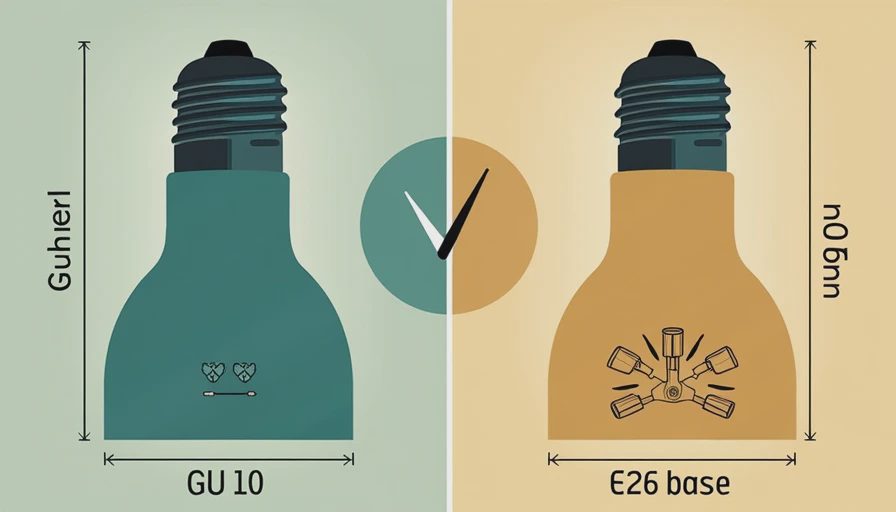
A GU10 bulb has two short pins with small feet that twist into matching slots in the socket. The “10” refers to the approximate 10-millimeter distance between the pin centers. This push-and-twist connection is common in track lights, recessed spotlights, and compact directional fixtures. GU10 lamps usually install directly into a 120-volt residential circuit in the United States, although the label on the fixture and bulb should always confirm voltage.
An E26 bulb uses the familiar medium Edison screw base found on many table lamps, floor lamps, pendant lights, and ceiling fixtures. The “26” identifies the base diameter in millimeters. You screw the bulb into the socket until it is seated; there is no twisting lock. In a practical GU10 vs E26 base comparison, the connection is the most important difference. A GU10 cannot screw into an E26 socket, and an E26 bulb cannot lock into a GU10 socket.
The base also hints at the fixture's intended job. GU10 usually points toward a focused beam, while E26 fixtures can accept a much wider range of decorative, omnidirectional, and high-output bulbs. Neither base is automatically better. Each solves a different design problem.
GU10 vs E26 base for brightness and beam control
Base type does not determine lumens, which measure the amount of light a bulb produces. A 600-lumen GU10 can be brighter than a 450-lumen E26, and a high-output E26 LED can easily exceed both. Look at lumens first when you need more or less light. For a kitchen work surface, a useful starting point is often several hundred lumens per fixture, spread across multiple fixtures rather than concentrated in one glaring source.
GU10 bulbs are often made as spotlights or narrow floodlights. Their beam angles may range from roughly 25 degrees for accent lighting to 60 degrees or more for broader coverage. A narrow GU10 can highlight artwork, a fireplace, or a textured wall, but it can create bright circles and dark gaps if spaced poorly. A wider beam is generally friendlier for general illumination.
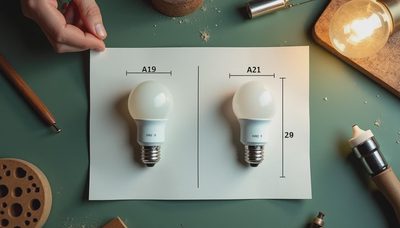
E26 bulbs are available in standard A19 shapes, globe bulbs, vintage-style filament designs, reflectors, and many other forms. An A19 LED sends light in several directions, making it useful in a table lamp or pendant with an open shade. A reflector E26 can provide more direction, but the fixture must have enough room for its larger shape. GU10 vs E26 base decisions should therefore include beam angle and bulb shape, not just socket compatibility.
Voltage, dimming, and fixture compatibility
In a typical American home, both GU10 and E26 bulbs can be designed for line-voltage use. That does not mean every bulb is interchangeable across every electrical system. Some small spotlights use a transformer or a low-voltage MR16 lamp that resembles a GU10 at a glance but has different pins. Read the marking on the existing bulb and fixture before ordering replacements. If the old lamp says MR16 with a GU5.3 base, it is not a GU10.
Dimming is another place where the GU10 vs E26 base question becomes more detailed. The base does not guarantee dimmer compatibility. Check that the LED bulb is specifically labeled dimmable and that its dimming range works with your wall control. Older dimmers designed for incandescent lamps can cause flicker, buzzing, or a limited low-light range with LEDs. A compatible LED dimmer often solves the problem, but the fixture, bulb, and control must work as a system.
For bathrooms and covered outdoor fixtures, confirm the bulb's damp-location rating. For fully exposed locations, use a bulb rated for wet locations. The socket size alone says nothing about moisture protection or heat handling.

Choosing the right base room by room
In a kitchen, GU10 recessed or track fixtures are useful when you want to aim light at counters, cabinet fronts, or a sink. They work especially well as part of layered lighting: focused task light at the work plane, softer ambient light elsewhere, and decorative light over an island. Select a beam wide enough to overlap neighboring pools of light instead of creating isolated bright spots.
E26 is often the more flexible choice for a bedroom, living room, or home office. A lamp with an E26 socket can take a warm 2700K LED for evening comfort, a brighter 3000K option for reading, or a decorative globe when the bulb is visible. In a home office, look for sufficient lumens and a shade that reduces glare rather than simply buying the highest-wattage replacement.
For a hallway or art wall, GU10 can provide precise accent lighting. Aim the fixture so the beam grazes artwork or lands on the walking surface without shining directly into eye level. For a dining pendant, E26 gives you more freedom to use a round globe, filament lamp, or frosted bulb that fills the shade evenly.
A simple shopping process
Start by turning off power and removing the existing bulb. Photograph the label, socket, and fixture before discarding anything. Identify whether the connection is a twist-lock GU10 or a screw-in E26, then record the voltage, bulb shape, lumen output, color temperature, and whether the old lamp was dimmable.
Next, measure the available clearance. A large globe E26 may touch a pendant shade, while a GU10 replacement can sit too deep or too far forward in a recessed trim. Match the beam angle to the purpose: narrow for an accent, medium for a counter or artwork, and wide for broader coverage. Finally, confirm the fixture's location rating and choose a reputable LED from brands such as Philips, GE, Feit Electric, or Sylvania when you want clear labeling and broad replacement availability.
The GU10 vs E26 base choice should be made before you compare finishes or decorative styles. A beautiful bulb is still the wrong purchase if the pins, screw diameter, voltage, or physical dimensions do not match.
The design decision behind the socket
The best choice depends on how you want the room to feel. GU10 fixtures encourage direction and control, making them strong tools for layered accent and task lighting. E26 fixtures offer versatility, decorative variety, and easy bulb changes. Many successful rooms use both: GU10 spots to shape the walls and E26 pendants or lamps to provide comfortable, visible sources.
If you are renovating, specify the socket together with the lighting purpose rather than selecting fixtures by appearance alone. For an existing room, compare the old bulb's markings, measure twice, and buy one replacement before ordering a dozen. Understanding GU10 vs E26 base turns a confusing label into a useful design decision, helping you create light that is comfortable, purposeful, and easy to maintain.