
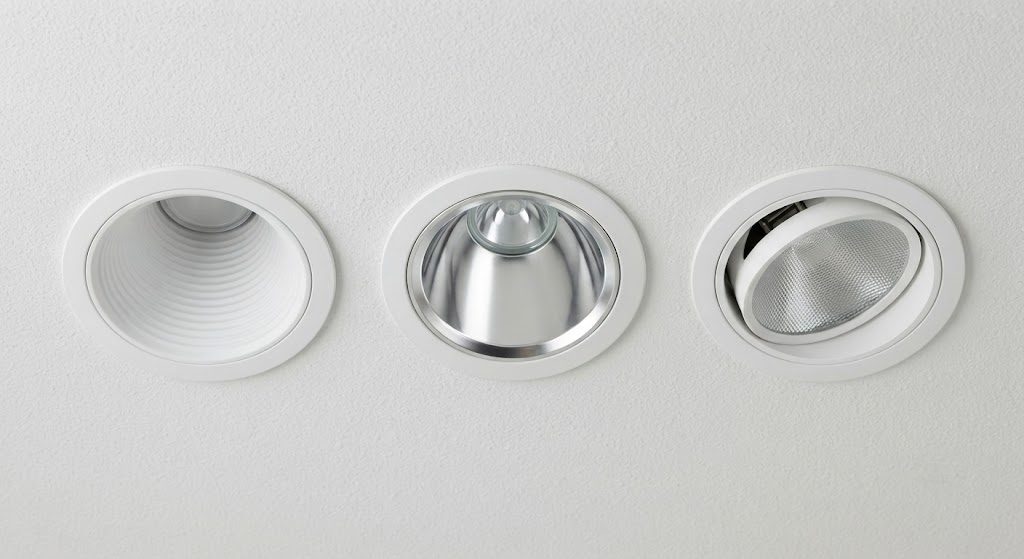
Builders love recessed lights. They're cheap, they disappear into the ceiling, and they let you check the "lighting" box with one trip to the supply house. The problem is that "recessed light" isn't one product — it's an entire category, and the choices you make inside that category determine whether your kitchen feels like a warm gathering space or an operating room.
The Housing: What Lives Above the Ceiling
Before you think about trims, you need the right housing — the metal can that sits in your ceiling cavity and holds the electrical components. The housing type depends entirely on when you're installing it.
New-Construction vs. Retrofit
If your ceiling joists are exposed during a renovation or new build, you use a new-construction housing. It's a rectangular metal frame that nails directly to the joists before drywall goes up. This is your golden window. You can position housings exactly where your lighting plan demands — centered on a counter, aligned with a hallway, spaced evenly for ambient wash — without compromise. Moving a housing six inches during rough-in costs nothing. Moving it after drywall costs hundreds.
If your ceiling is already finished, you need a remodel or retrofit housing. This pushes up through a hole cut in the drywall and clamps into place from below. Retrofit units are lifesavers for adding lights to an existing room, but you're limited by joist locations and wire access. You'll almost always need an electrician.
Either way, check one spec: IC-rated. If the housing will touch insulation — and it almost certainly will in an attic — an IC-rated housing prevents overheating and keeps your home safe.
Trims: The Part You Actually See
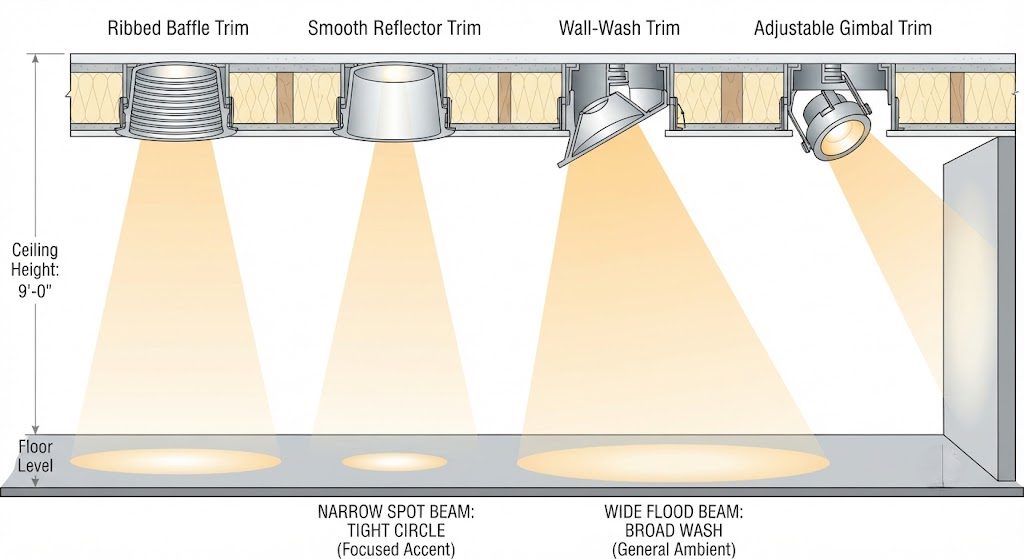
The trim is the visible ring and internal reflector that shapes the beam. Four types cover nearly every residential need.
Baffle, Reflector, Wall-Wash, and Adjustable
A baffle trim has concentric ridges that trap and absorb stray light, reducing glare. It's the most common trim and does fine for general ambient light in bedrooms and living rooms. But it absorbs some output, so you'll need more fixtures to reach the same brightness.
A reflector trim has a smooth, polished interior that pushes every lumen out of the fixture. It's brighter and more efficient, but you'll see the bulb and some glare if you look directly at it. Good for kitchens and bathrooms where you need maximum task light and people aren't staring at the ceiling.
A wall-wash trim throws light asymmetrically — mostly toward one side — so it paints your walls with even illumination. This is how you get that soft, gallery-like ambient layer in a living room. Place these around the perimeter, aimed at the walls, and the reflected light makes the whole room feel larger.
An adjustable or gimbal trim lets you aim the beam. Non-negotiable for accent lighting. Use these to highlight art, a textured fireplace, or a bookshelf that deserves attention.
Beam Angle: The Spec That Shapes the Floor
Beam angle is the spread of light measured in degrees. A narrow spot (15 to 25 degrees) creates a tight circle. A wide flood (40 to 60 degrees) washes a broad area.
Narrow Spot vs. Wide Flood
For a standard 9-foot ceiling with recessed lights spaced about 4 to 5 feet apart, you want a wide flood — at least 40 degrees. If you accidentally install narrow spots in your ambient grid, you'll get bright islands of light on the floor separated by dark valleys. That's not layering. That's a lighting failure.
Reserve narrow beams for accent, always paired with an adjustable trim so you can fine-tune the aim. And when your electrician asks if you want 4-inch or 6-inch housings, know this: smaller apertures look more modern and less commercial, but you'll need more of them. The choice ripples through your entire plan.
The next time someone tells you "we'll just throw some recessed lights in," ask three questions: what housing, what trim, and what beam angle. If they can't answer, call someone who can.