Recessed lights fill the ceiling. Pendants define islands and tables. Floor lamps anchor seating areas. But the walls — the largest vertical surfaces in any room — usually sit in darkness. That's a missed opportunity, because lighting the walls is one of the most effective ways to make a room feel larger and more sophisticated.
Wall sconces are the tool for that job. But they're almost always used wrong. Most people buy sconces because they look good in a catalog, then mount them at random heights on random walls and hope for the best. A sconce without a purpose is just wall decor that requires an electrician. Used intentionally, it's one of the most versatile fixtures in your lighting plan.
What Sconces Actually Do
A sconce's primary job isn't to light the floor or the ceiling — it's to put light on a vertical plane. That vertical light creates a sense of depth and enclosure that overhead fixtures alone cannot produce. Here's how that plays out in real rooms.
They Make Hallways Feel Like Rooms
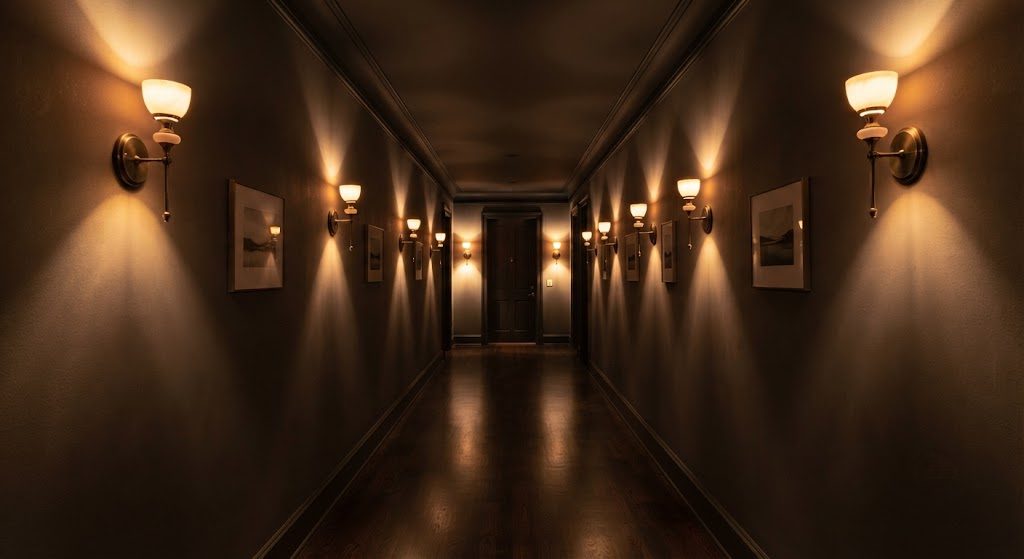
A hallway lit only by recessed ceiling lights is a tunnel — bright on the floor, dark on the walls, and visually compressed. Mount sconces along one or both walls at eye level, and suddenly the corridor has rhythm. The light grazes the wall surface, reveals texture, and draws people through the space. This is how high-end hotels treat their corridors, and it works identically in a residential hallway.
They Frame a Living Room Without Adding Clutter
Floor lamps take up floor space. Table lamps occupy surface area. Sconces mount on the wall and consume zero square footage. Place a pair flanking a sofa or on either side of a console table, and you get warm pools of light exactly where people sit without cluttering the room with furniture that exists just to hold a lamp.
They Eliminate Bathroom Face Shadows
I touched on this in the bathroom lighting guide, but it bears repeating: a single overhead fixture above a vanity mirror casts deep shadows under your eyes, nose, and chin. Vertical sconces mounted on either side of the mirror at face height — roughly 60 to 66 inches from the floor — fill those shadows and render faces evenly. This is the single highest-impact lighting change you can make in a bathroom.
The Mounting Height Formula
The most common sconce mistake is mounting them too high. Here's the rule: the center of the sconce should sit at 60 to 66 inches above the finished floor. That puts the light source at approximately eye level for a standing adult, which is where it creates the most flattering illumination and the least glare.
Why 60 to 66 Inches Works Across Ceiling Heights
This range holds whether your ceilings are 8 feet or 12 feet. The relationship that matters is between the light source and human height, not between the fixture and the ceiling. Mounting a sconce at 72 inches or higher pulls the light above eye level and reduces it to weak ambient fill. Mounting below 60 inches risks glare from the bulb entering your peripheral vision when seated.
The exception is sconces flanking a bed. These should mount slightly lower — roughly 48 to 54 inches — so the light sits at comfortable reading height when you're propped up against pillows.
Choosing the Right Sconce
Not every sconce does the same job. The direction of the light matters more than the style of the fixture.
Up-Light, Down-Light, and Directional
An up-light sconce throws most of its output toward the ceiling, where it bounces back down as soft, diffused ambient light. These are ideal for living rooms and dining rooms where you want indirect, atmospheric illumination. A down-light sconce pushes light toward the floor and works well in hallways and stairwells where you need to see where you're walking. A directional sconce with an adjustable head lets you aim light at art, a reading chair, or a specific architectural detail.
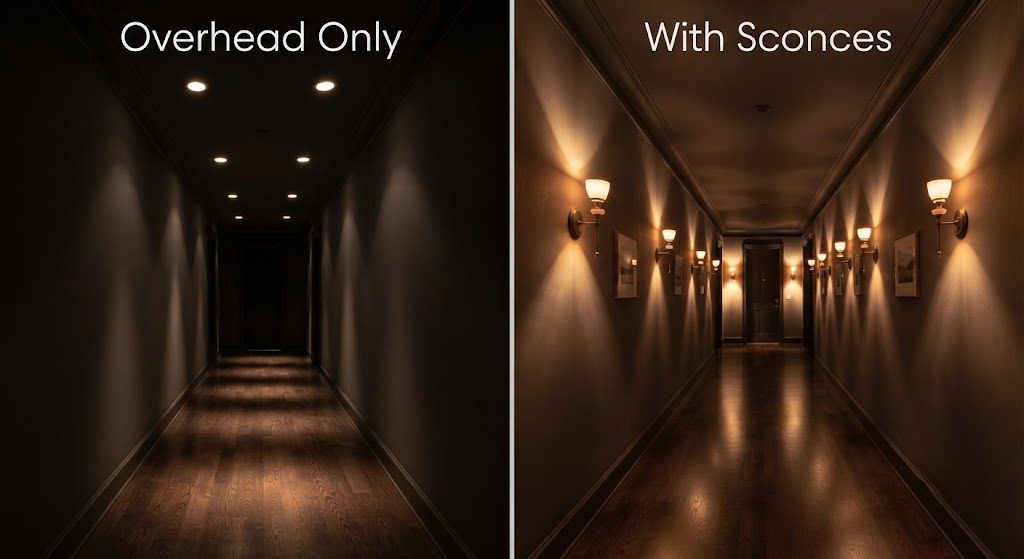
Sconces in Your Lighting Plan
Wire sconces on their own circuit, separate from overhead ambient lights. This lets you switch off the ceiling and let the sconces do the work — creating a lower, more intimate atmosphere without plunging the room into darkness. In a living room or dining room, a circuit of wall sconces dimmed to 50 percent is often the only light you need for an evening at home.
Think of sconces as the vertical dimension of your layered lighting plan. Ceiling fixtures handle the horizontal plane. Table and floor lamps handle specific tasks. Sconces light the space in between — and that's often where a room's character lives.