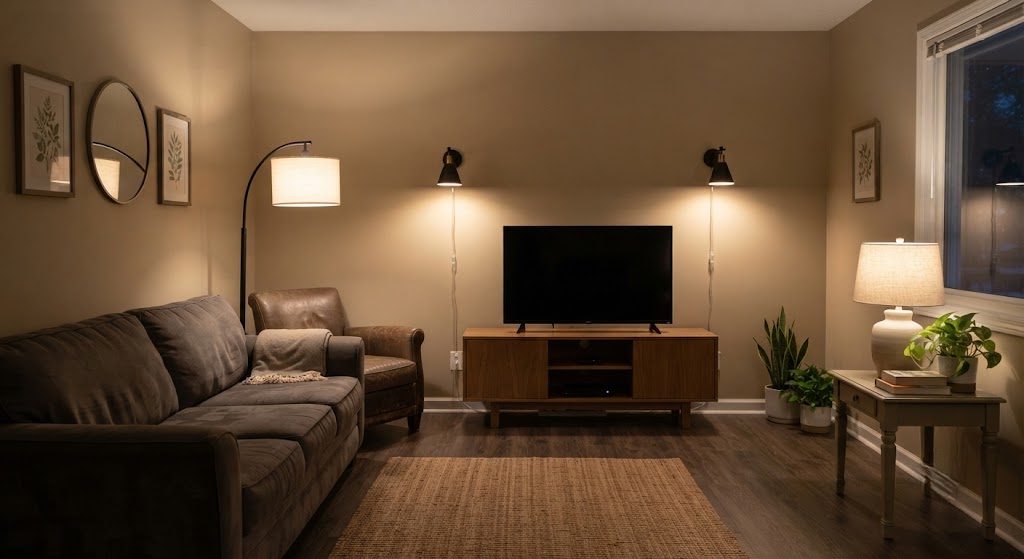
The biggest objection I hear from homeowners isn't "I don't understand lighting." It's "I can't afford good lighting." They've seen layered lighting in magazines and hotel lobbies, and they assume it requires a recessed grid, custom cabinetry with integrated LEDs, and an electrician camped in the house for a week. The assumption is wrong, and it stops people from making changes that would cost less than the sofa they're sitting on.
I've designed lighting for living rooms at every budget level, from $300 plug-and-play setups to $15,000 architectural installations. The rooms that feel best at night don't always correlate with the receipts. What correlates is whether someone thought about layers before they opened their wallet.
The Budget Trap
The trap works like this: you know the living room doesn't feel right after dark, so you go to a lighting showroom or a big-box store. You find a beautiful chandelier or a dramatic floor lamp, spend your entire lighting budget on one fixture, bring it home, and install it. The room still feels flat because one fixture can't do the job of three layers, no matter how much it cost.
Why One Expensive Fixture Fails
A $1,200 pendant in the center of your living room is still just one light source. It'll cast a cone of light downward, leave the corners dark, and do nothing for the art on your walls. The room will feel exactly as flat as it did with the $40 flush mount — just with a prettier fixture in the middle of the darkness.
The budget version of this mistake is buying a six-pack of cheap recessed retrofit kits and dotting them evenly across the ceiling. Now you have six light sources instead of one, but they're all doing the same job — ambient downlight — and the room has brightness but no depth. I covered the trim and beam angle choices that matter for recessed lights in an earlier post, but the bigger point here is that more fixtures doesn't equal layered lighting.
Three Layers, Real Budget
Here's a complete living room lighting plan for a typical 14-by-18-foot space, priced as of 2026, using a mix of plug-in fixtures and one small hardwired job.
Ambient Layer: The Room Wash
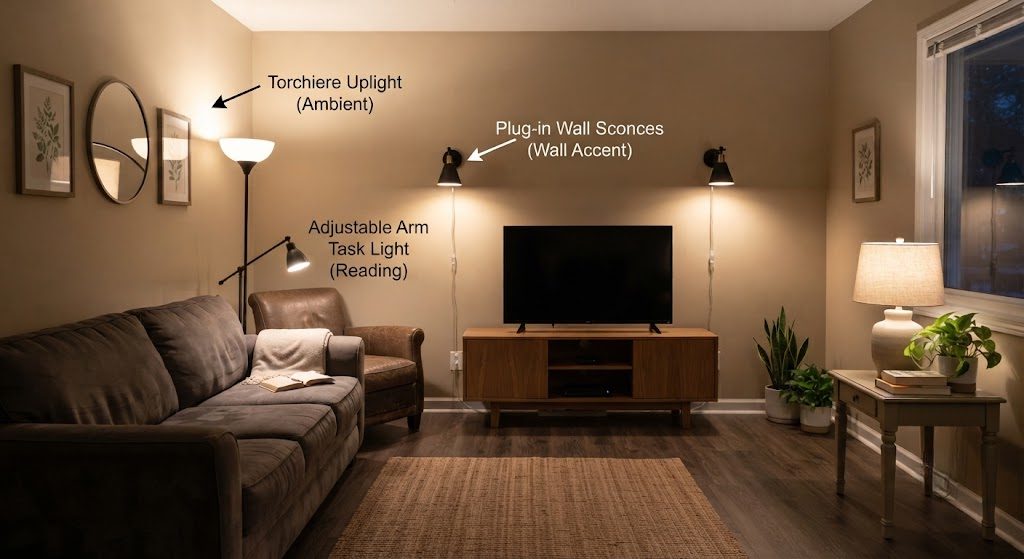
Instead of recessed lights, use two plug-in torchiere floor lamps placed in opposite corners of the room. A torchiere throws light upward onto the ceiling and upper walls, where it bounces back down as soft, shadowless ambient fill. This is the same indirect light principle I discussed in the Mexico City hotel lobby case study — just adapted for a $40 floor lamp from a hardware store.
Place one in the corner behind the main seating area and one diagonally opposite. Plug each into a smart outlet or a plug-in dimmer. Total cost for the ambient layer: approximately $80 to $120 for both lamps, plus $30 for two smart plugs that give you dimming control without touching the wall switches.
Task Layer: Where People Sit
A floor lamp with an articulated arm and an opaque shade goes next to the primary reading chair. The shade directs light exactly where the reader needs it, and the opaque sides prevent glare from hitting other people in the room. Position the bottom of the shade at roughly 48 inches from the floor — just above shoulder height when seated. This puts the light source in the right relationship to the book or tablet without shining directly into anyone's eyes.
If the sofa is the main seating area, a console table behind it with two small table lamps provides task light for conversations and drinks without cluttering the coffee table. Look for lamps with a simple linen or frosted shade that diffuses light sideways as well as downward.
Cost for the task layer: approximately $60 to $100 for the reading floor lamp, $80 to $120 for the console lamps. If you already own lamps that work, this number drops to zero.
Accent Layer: The Walls and Details
This is where you might need an electrician — but only for an hour or two. Two plug-in wall sconces mounted on either side of a large piece of art, a media console, or a bookshelf create the vertical dimension that makes a room feel composed. Choose sconces with a cord that can be run cleanly down the wall or concealed with a paintable cord cover. Total cost: approximately $80 to $150 for the pair of sconces, plus $100 to $200 for the electrician if you choose hardwired versions.
What You Don't Need
You don't need recessed lights. You don't need smart bulbs. You don't need a lighting control system. You need three layers, each on its own control — and that control can be as simple as reaching over to turn on a floor lamp.
The framework I laid out in the very first posts on The Fixture Guide — ambient, task, accent — works regardless of budget because it's about where light comes from, not how much the fixtures cost. The rooms I'm proudest of aren't the ones with the biggest budgets. They're the ones where someone applied the framework and made their home feel right for the first time after dark.
In the next post, I'll take you inside a restaurant where the light sources are completely invisible — and show you what homeowners can steal from commercial hospitality design.