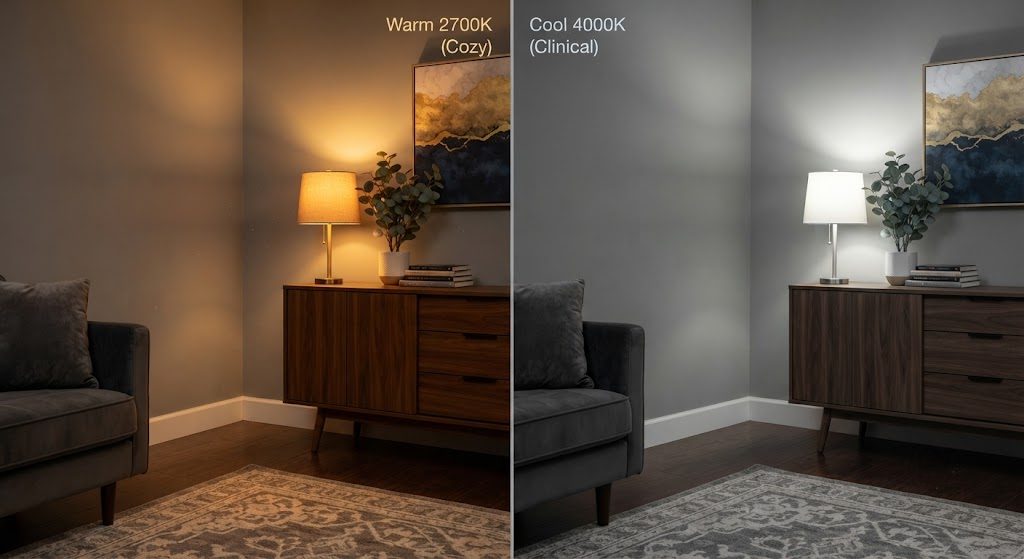
Walk down the lighting aisle and you'll see labels like "warm white," "cool white," and "daylight" on every box. Most people grab whatever sounds pleasant or whatever they bought last time. That's a mistake, and it's one I see in roughly half the homes I consult on: beautiful rooms that feel wrong because the light itself is the wrong temperature.
Color temperature isn't a mood ring. It's a specification that determines how colors render, how materials look, and how your body responds to a space after sunset. Treat it like a tool, and your rooms will feel intentional. Treat it like a preference, and you'll wonder why your kitchen looks like an office.
What Kelvin Numbers Actually Mean
Color temperature is measured in Kelvin (K) and describes the color of light a bulb produces — from warm amber to cool blue. The scale runs backward from what most people expect: lower numbers are warmer, higher numbers are cooler. Here's what the three residential ranges actually do.
2700K — The Warm Glow
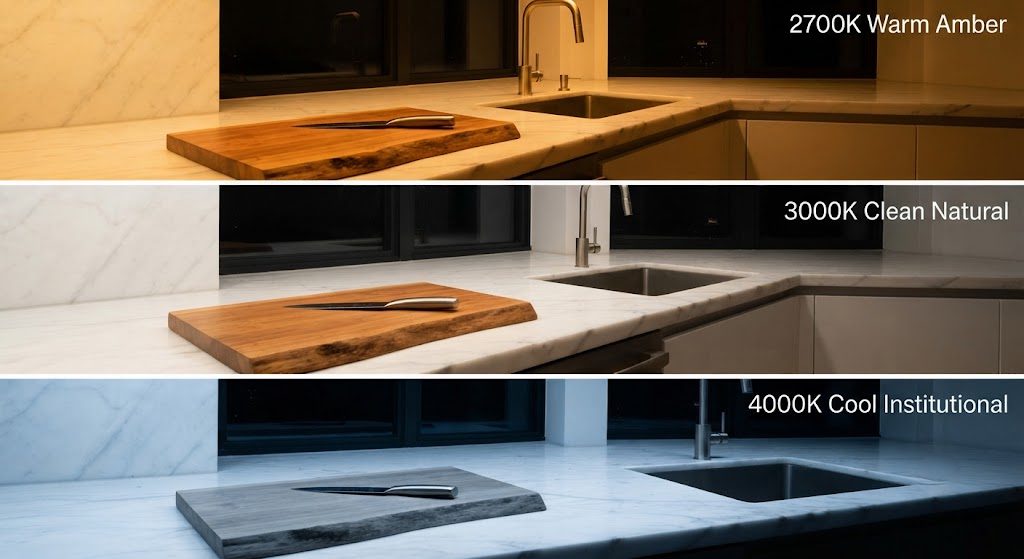
This is the color of incandescent bulbs and firelight. It renders skin tones warmly, makes wood and leather look rich, and signals to your brain that it's evening. 2700K belongs in living rooms, bedrooms, and dining rooms — any space where you want people to feel relaxed and stay awhile.
3000K — The Neutral Middle
Slightly cooler than incandescent but still warm. At 3000K, whites look cleaner, countertops look crisper, and colors read more accurately without feeling clinical. This is my default for kitchens, home offices, and bathrooms. It provides enough clarity for tasks without sacrificing warmth.
4000K — The Cool White
This is where light starts to feel commercial. 4000K is common in offices, garages, and retail spaces because it promotes alertness and renders fine detail well. For a home, use it sparingly — laundry rooms, workshops, inside a pantry — and only if you genuinely need that level of acuity.
How to Choose the Right Tool for Each Room
The rule isn't "pick one temperature for the whole house." It's "pick the right temperature for what happens in each room" — and never mix them within the same sightline.
Match the Function, Not the Mood
A kitchen lit only with 2700K will feel dim and tired even with adequate brightness. Your whites will look cream, your vegetables will look dull, and you'll strain to see what you're chopping. Put 3000K over the counters and island, and the space immediately becomes more usable without feeling harsh.
A bathroom with a 4000K ceiling fixture is worse. That cool light casts blue shadows on your face and makes everyone look sleep-deprived. Stick to 3000K at the vanity, with fixtures placed at face height on both sides to eliminate shadows — a topic I covered in detail when discussing bathroom lighting mistakes earlier in this series.
Bedrooms want 2700K exclusively. Anything cooler will suppress melatonin and make it harder to wind down. If you have a reading lamp on the nightstand, keep it warm.
The Mixed-Temperature Mistake
The quickest way to make a room feel unsettled is to install different color temperatures that are visible at the same time. If your kitchen has 3000K recessed lights but a 2700K pendant over the island, the two will clash. One looks intentional; the other looks like a mistake. Always standardize within a room, and test bulbs from the same batch — even same-model LEDs can vary between production runs.
The One Temperature You Can Skip
Retail shelves push "daylight" bulbs at 5000K and above. These mimic noon sun and have a place in garages, workshops, and maybe a utility closet. They do not belong in living spaces. 5000K light in a living room feels like an interrogation. Unless you're performing surgery on your coffee table, leave the daylight bulbs at the store.