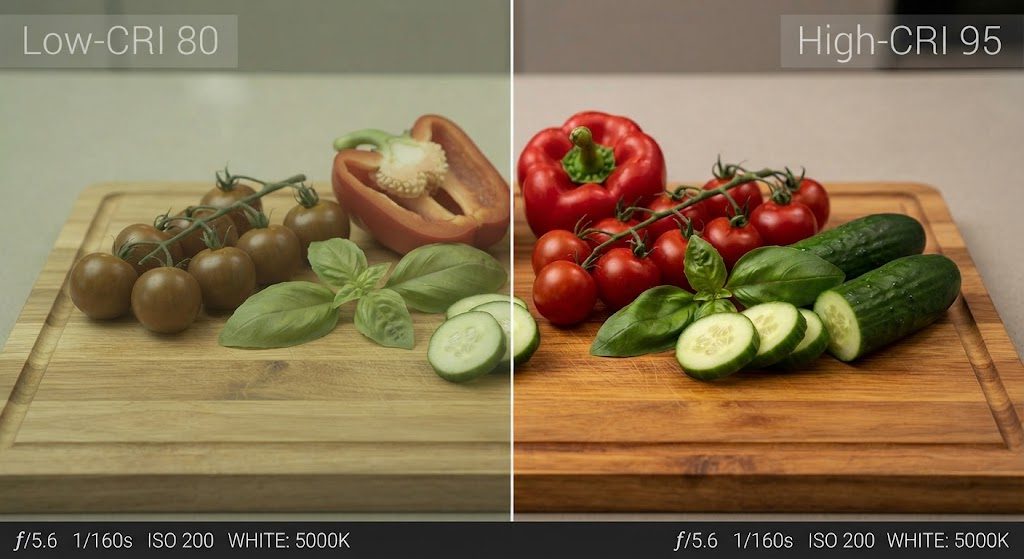
Walk into a lighting showroom and pick up two 3000K LED bulbs from different manufacturers. Same wattage, same base, same claimed color temperature. Install them side by side in your kitchen. One will make your tomatoes look ripe and red. The other will make them look brownish and tired. The difference isn't brightness or color temperature. It's a spec most homeowners have never heard of: CRI.
CRI stands for Color Rendering Index. It measures how accurately a light source reveals the colors of objects compared to a reference light source — typically daylight or incandescent — with the same color temperature. The scale runs from 0 to 100. A score of 100 means the light renders every color exactly as the reference would. The lower the number, the more colors shift, fade, or turn strange under that light.
What CRI Actually Measures
The test uses eight standard color samples — think muted pastels, not the vivid reds you actually care about in your kitchen. A bulb's CRI score is the average of how well it renders those eight samples. This is why CRI has limitations, and why you'll sometimes hear lighting professionals talk about R9 as the real test of color quality.
R9: The Red That CRI Hides
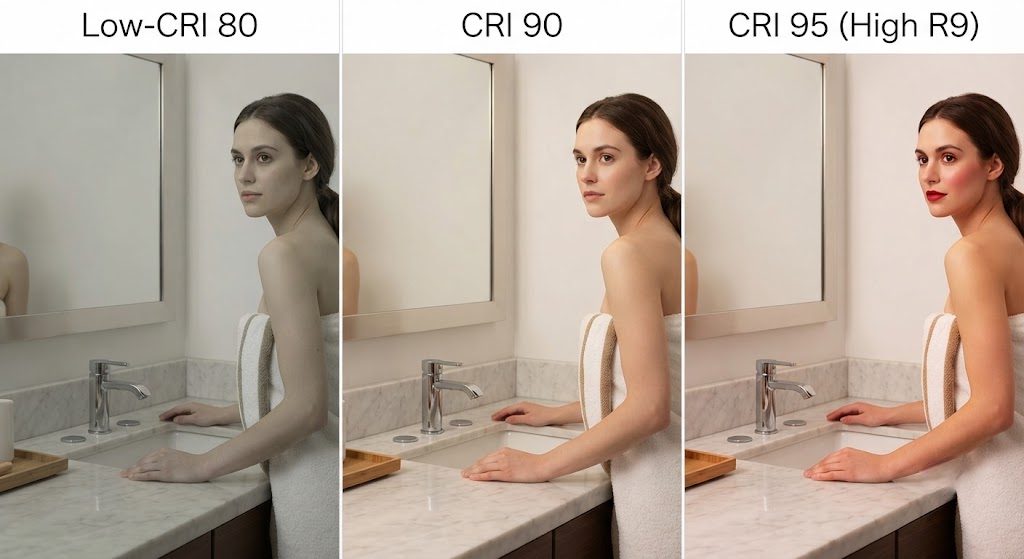
The standard CRI calculation doesn't include R9, which measures how a light source renders deep red. That's a problem because red is everywhere in a home: raw meat, red peppers, wood tones, skin tones, brick, warm paint colors. A bulb can score a respectable 85 CRI while having an R9 value near zero — meaning it makes everything with red undertones look lifeless.
This is why I don't just look at the CRI number. I check R9. For kitchens, bathrooms, and anywhere people will be photographed or seen up close, I want R9 above 50. Above 70 is excellent. High-end residential LEDs hitting 90+ CRI almost always include strong R9 performance, but always verify if the spec sheet provides it.
Why 90+ Is the Residential Floor
Most builder-grade recessed lights and cheap LED bulbs score between 80 and 85 CRI. That sounds close to 90, but the difference is visible the moment you compare them side by side. Here's what happens in the rooms that matter most.
Kitchen Countertops, Skin Tones, and Food
In a kitchen, low CRI makes fresh food look wrong. Red bell peppers go muddy, leafy greens lose their vibrancy, and raw chicken takes on a grayish cast that makes it harder to judge doneness. White countertops under 80 CRI light often look dingy or faintly green — you'll scrub them thinking they're dirty when the problem is the bulb above them.
Bathrooms are worse. Low CRI light pulls the warmth out of skin tones, making everyone look pale and tired. Apply makeup under 80 CRI LEDs and you'll step outside into daylight looking like a different person. This is the same principle I discussed in the bathroom lighting guide — fixture placement matters, but so does the quality of the light itself.
Living rooms with wood floors, leather furniture, and warm wall colors suffer under low CRI because all the red and brown tones flatten out. The room doesn't feel cozy; it feels off, and most people can't pinpoint why.
Where CRI Matters Less
You don't need 95 CRI in every socket in your home. Closets, laundry rooms, utility spaces, and outdoor security lights can perform perfectly well with CRI in the low 80s — you're not evaluating color in those spaces, you're just moving through them.
The priority list: kitchens and bathrooms get the best, followed by living and dining rooms, then bedrooms, then everything else. Budget isn't wasted on high CRI where it won't be noticed. It's spent where it will.
When you're shopping, look for bulbs that explicitly state CRI 90+ — and ideally provide the R9 value. Terms like "high color rendering" without a number are meaningless marketing. If the CRI isn't on the box, assume it's 80.
The good news is that 90+ CRI LEDs are no longer niche products at exotic prices. They've become widely available and the price premium over standard LEDs has shrunk dramatically. Given that these bulbs will be in your home for a decade or more, the cost per year of better color rendering rounds to roughly zero.