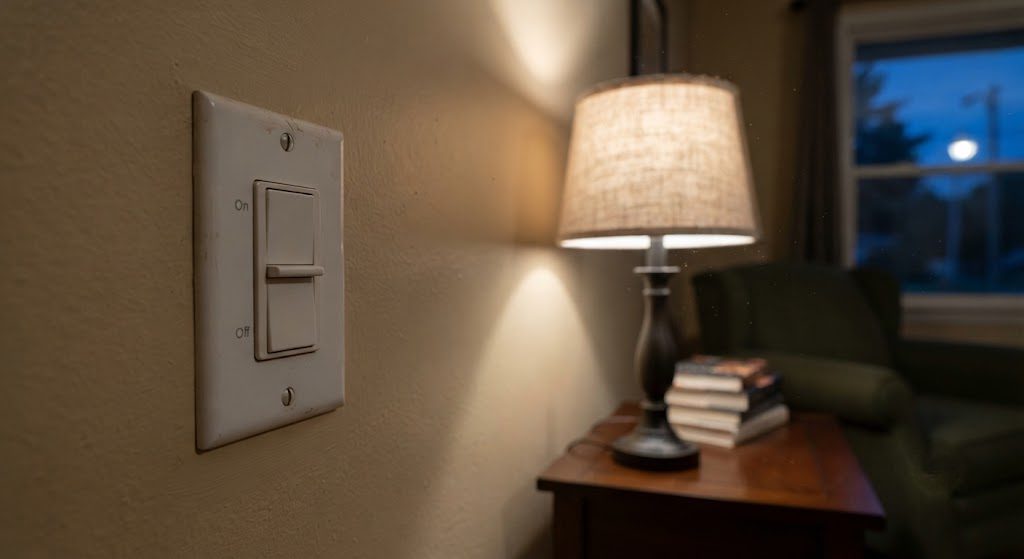
There's a special kind of frustration that comes from flipping a dimmer switch and hearing your new LED bulbs buzz like a trapped fly. Or watching them flicker at low levels. Or realizing they go from "bright" to "off" with barely any dimming range in between. You might blame the bulbs. The real problem is often older and sitting inside your wall.
Dimmer compatibility is the most overlooked spec in residential lighting. Most homeowners — and plenty of electricians — assume any dimmer works with any bulb, as long as the wattage matches. That was true in the incandescent era. It's absolutely not true with LEDs, and ignoring it leads straight to flicker, buzz, and a dimming curve that's closer to an on-off switch.
Why Your LEDs Don't Dim Like Old Bulbs
An incandescent bulb is a simple resistive load. Turn down the voltage, and the filament glows less. An LED is a piece of electronics — a driver converts AC power to low-voltage DC, and that driver has to interpret what the dimmer is doing. If the driver and the dimmer aren't speaking the same language, the result is noise, flicker, or a limited dimming range.
The Dimmer-Bulb Dialogue
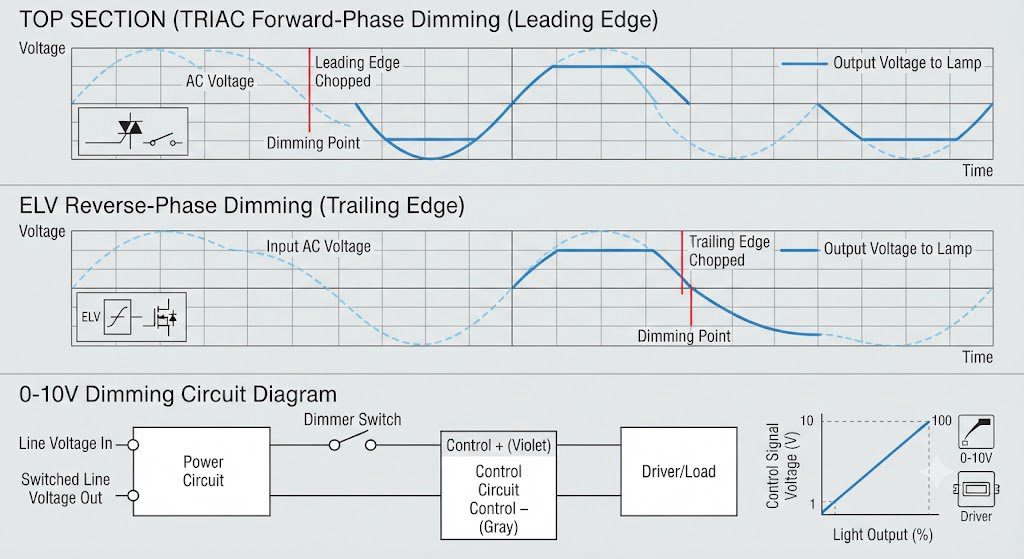
A dimmer works by chopping up the AC waveform — turning the power on and off rapidly to reduce the total energy delivered. The method of chopping is what defines the dimming technology. Incandescent bulbs don't care how you chop the waveform. LED drivers care a lot. Use the wrong dimmer type, and the driver misreads the chopped signal, causing the light to pulse, flicker, or shut off entirely.
ELV vs. TRIAC vs. 0-10V: Three Technologies
There are three common dimming methods in residential and light commercial settings. Knowing which one your fixture needs is half the battle.
TRIAC (Forward-Phase) Dimming
TRIAC is the legacy standard. It chops the leading edge of the AC waveform and was designed for incandescent and magnetic low-voltage loads. Most dimmers in American homes are TRIAC — they're cheap and common. Some LED bulbs are marketed as "TRIAC compatible," but performance varies widely. You'll often get a usable range of only 30 to 100 percent, with flicker or dropout below that. For basic hallway or closet lights, TRIAC can be fine. For a living room where you want candlelit ambiance, it's a gamble.
ELV (Reverse-Phase) Dimming
ELV dimmers chop the trailing edge of the waveform, providing a smoother signal that LED drivers handle far more gracefully. They were originally designed for electronic low-voltage transformers, but they happen to work beautifully with most high-quality LED fixtures. An ELV dimmer paired with an ELV-compatible fixture will typically give you smooth dimming from 100 percent down to 5 or even 1 percent, with zero buzz. This is my default recommendation for any room where dimming matters — living rooms, dining rooms, bedrooms, and home theaters.
ELV dimmers require a neutral wire in the switch box, which most homes built after the 1980s have. If your home is older, you'll need to check before committing. They also cost more than TRIAC dimmers, but the difference in performance is immediate and obvious the first night you use them.
0-10V Dimming
0-10V is a commercial technology that uses a separate pair of low-voltage control wires to tell the driver how bright to be. It's the smoothest and most reliable dimming method available, routinely reaching 1 percent or lower. You'll see it in architectural fixtures and some high-end residential products. It requires running additional control wiring between the dimmer and the fixture, which makes it impractical for retrofit but completely reasonable for new construction or major renovations where walls are open.
How to Match the Right Dimmer
Start with the fixture manufacturer's specification sheet. It will list compatible dimmer types and often specific dimmer model numbers. If it says "ELV only," install an ELV dimmer — period. If it lists specific compatible TRIAC dimmers, use one from that list exactly. Generic "LED compatible" labels on dimmers mean nothing without testing.
When the spec sheet isn't available, the safest play is an ELV dimmer from a reputable manufacturer paired with a fixture you know supports reverse-phase dimming. Test one fixture and dimmer together before committing to an entire room. I've covered fixture build quality in previous posts, and the same rule applies here: buy from manufacturers who publish real electrical specs, not just wattage and color temperature.
In my next post, I'll walk through a full lighting plan for a home office, where task light and glare reduction matter more than anywhere else. But for every room, the dimmer is the last decision that determines whether the entire system feels premium or cheap. Don't let a twenty-dollar dimmer undermine a two-thousand-dollar lighting plan.